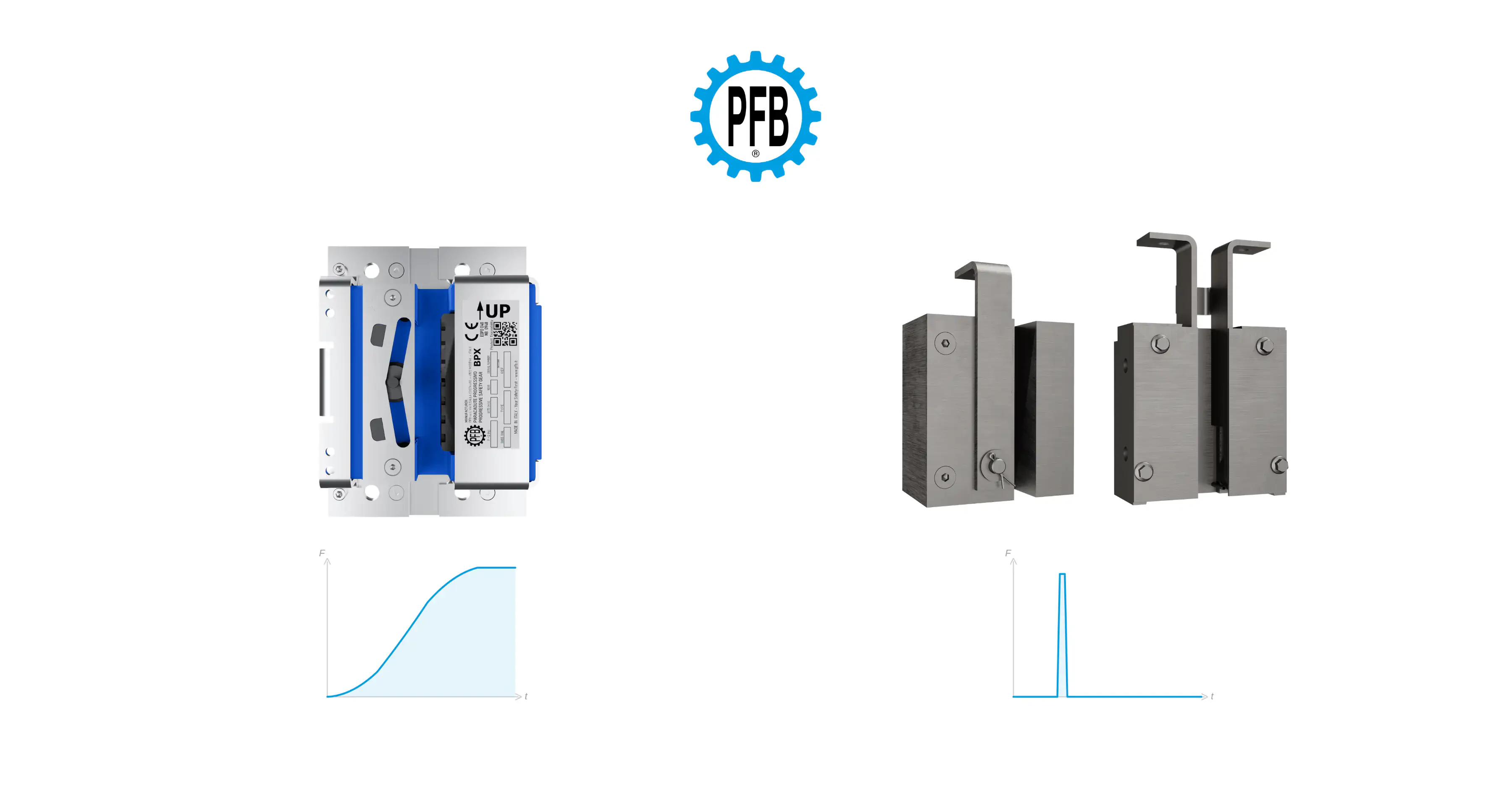
The instantaneous or progressive safety gear, together with the overspeed governor, plays a fundamental role in the safety of the lift and the people inside it. It is a roller-type safety braking device whose operation is directly linked to that of the overspeed governor. In other words, the safety gear is the device that brings the installation to a stop when the overspeed governor intervenes, which activates if any anomaly is detected during the travel of the lift car.
How does the safety gear work?
It all starts with the overspeed governor. When the tripping speed is exceeded — that is, when an abnormal acceleration is detected in the installation — the overspeed governor activates, sending a mechanical signal to the safety gear linkage, which engages by gripping the guide rail and bringing the installation to a standstill.
Does the safety gear require maintenance?
The safety gear does not normally require any maintenance. However, it is advisable to carry out an inspection of the device twice a year. The maintenance technician should check for wear and verify the correct operation of the device, without interfering with its functioning in any way.
What does standard EN 81-20 say about safety gear?
EN 81-20 defines the safety requirements for the construction and installation of lifts, establishing the conditions of use for safety gear based on the rated speed of the installation. According to the standard, the type of safety gear — instantaneous or progressive — must be selected in accordance with the rated speed of the installation and the rated load of the car.
What types of safety gear does PFB supply?
PFB manufactures a wide range of safety gear, both instantaneous and progressive, for different guide rail sizes and rated loads, suitable for a variety of installation types.
Instantaneous:
SP 50 – SP 50/B – SP 60 double-roller: suitable for any type of installation, for guide rails from 6 to 16 mm and a maximum rated load of 3,924 kg.
BP1 - BP2 - BP3 single-roller: ideal for homelifts, hydraulic lifts and rope lifts, for guide rails from 5 to 9, 10 and 16 mm, with a maximum rated load of 4,059 kg.
BP4 single-roller: reduced depth. For guide rails from 8, 9 to 10 mm, with a maximum rated load of 1,641 kg.
BP100 high-capacity single-roller: designed for installations with extremely high rated loads such as platforms and goods lifts, for guide rails from 16 to 19 mm and a maximum rated load of 11,296 kg.
Progressive:
BPX with a rated load up to 2,826 kg, for drawn, machined, oiled and dry guide rails from 8 to 16 mm. Available with a complete actuation kit and synchronisation shafts from 500 to 4,000 mm. Maximum tripping speed 2.5 m/s. Certified to EN 81-21 and EN 81-20/50.
What is the difference between instantaneous and progressive safety gear?
The difference between the two types of safety gear lies in the type of engagement.
The instantaneous safety gear brings the installation to an abrupt and immediate stop. It is suitable for installations with rated speeds up to 0.63 m/s.
The progressive safety gear applies a gradual braking action, reducing the deceleration forces on the structure. It is suitable for installations with rated speeds up to 2.50 m/s.