When it comes to lift safety, the tensioner is one of those components that works silently but plays a fundamental role. It keeps the overspeed governor rope under constant tension and ensures that the safety contact intervenes promptly in the event of excessive slack. On this page you will find everything you need to know: how it works, how to pair it with the overspeed governor, and what the differences are between the available models.
What is a lift tensioner?
The lift tensioner is a device that keeps the overspeed governor rope under tension. It is fitted with a safety contact that cuts power to the installation if the rope becomes slack due to excessive elongation, ensuring the correct mechanical operation of the overspeed governor.
How do you choose the right tensioner to pair with the overspeed governor?
There are two aspects to consider when pairing an overspeed governor with a PFB tensioner.
Pulley: the pulley diameter of the overspeed governor must match the sheave diameter of the tensioner.
Counterweight: depending on the overspeed governor being paired, a different counterweight will be applied to the tensioner.
No counterweight is required when a spring tensioner is used in the installation.
In addition, on each overspeed governor product page you will find the compatible PFB tensioners for every model.
Does the tensioner require maintenance?
No. However, it is important to check the correct operation of the safety contact and the rope tension during routine maintenance of the installation.
If I replace the overspeed governor during maintenance, do I also need to replace the tensioner?
When replacing an overspeed governor, you must ensure that the new governor is compatible with the sheave diameter and the weight of the tensioner already installed. If it is not, the tensioner must also be replaced to avoid compromising the correct operation of the overspeed governor.
What does standard EN 81-20 say about tensioners?
EN 81-20 requires tensioners to be fitted with a counterweight. However, a manufacturer such as PFB can, through its own risk assessment, design and produce tensioners based on alternative technologies — such as spring tensioners — and supply them with the corresponding certificate.
PFB tensioners
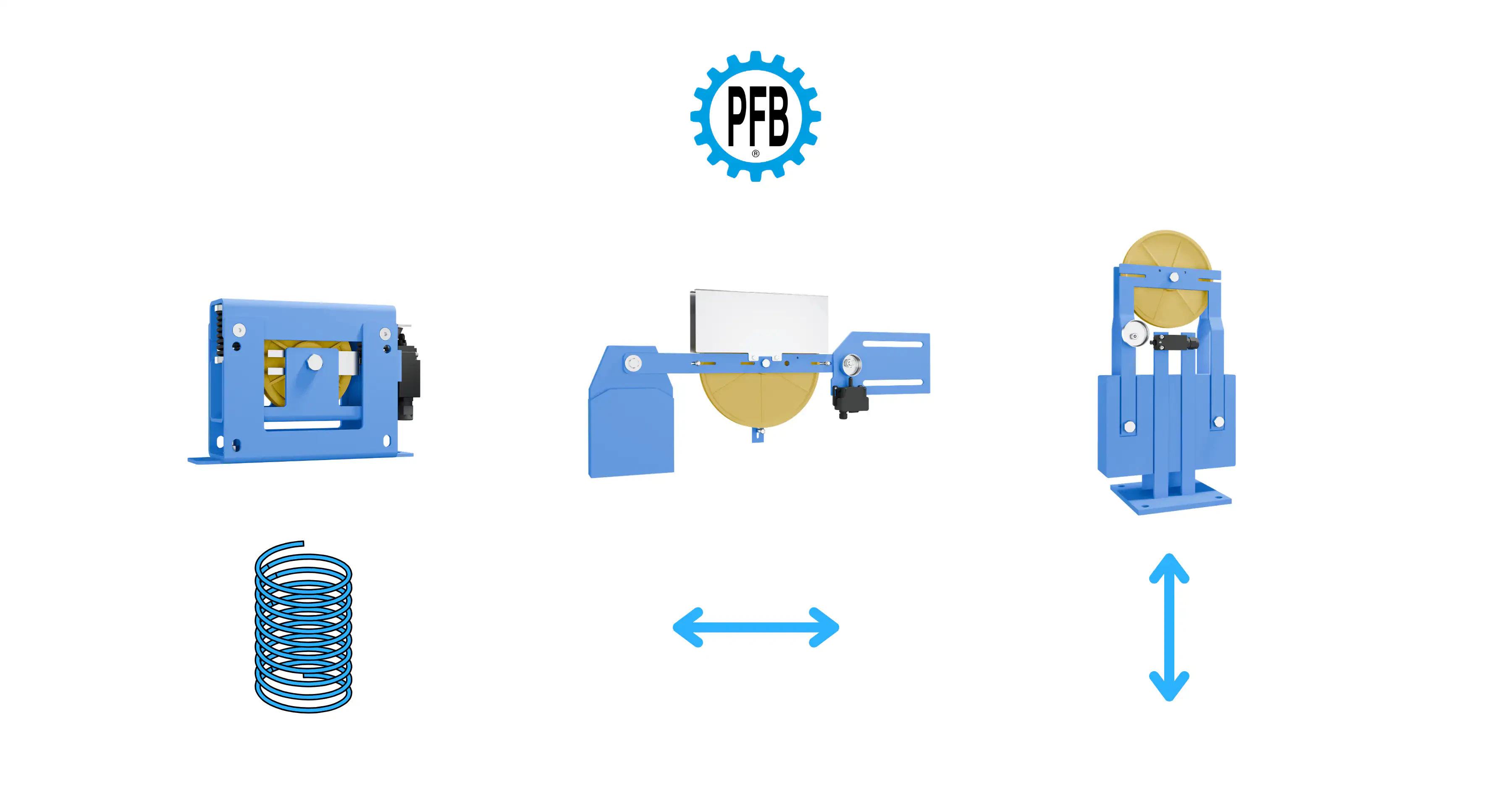
PFB has been manufacturing lift tensioners for over 60 years, designed to meet any installation configuration. Every model is designed in compliance with EN 81-20, or by derogation through the relevant certificate, and supplied with the technical documentation required for installation. The range is divided into three families — spring, horizontal and vertical — each designed for specific installation conditions, described in detail below.
What is the difference between a spring, horizontal and vertical tensioner?
The spring tensioner can be fixed to the floor or to the guide rail. Being spring-based, it requires no counterweight, making it easier to handle and install in confined spaces.
Discover PFB spring tensioners: R4MC - R4M
The horizontal tensioner is fixed to the guide rail and is cantilevered, with the counterweight on the opposite side to the sheave.
Discover PFB horizontal tensioners: R4X - R4K
The vertical tensioner has the counterweight in line with the sheave and can be fixed to the guide rail and/or to the floor.
Discover PFB vertical tensioners: R4VS - R4R - R4V.