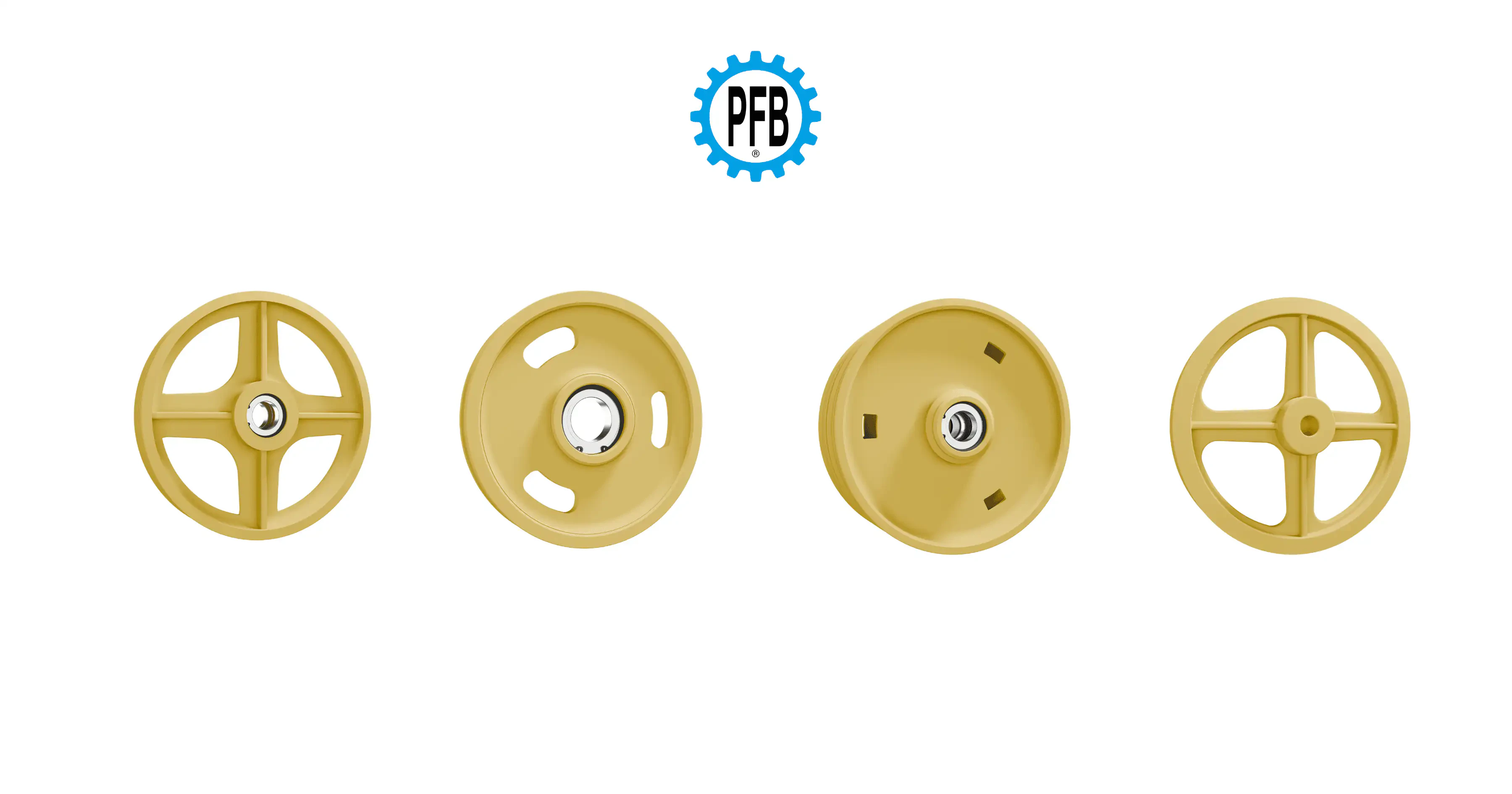
Pulleys are fundamental components of any lift installation: they guide and transmit the movement of the ropes, ensuring the correct operation of the car. On this page you will find everything you need to know: how they work, what types exist and how to choose the most suitable pulley for your installation.
What is a lift pulley?
A lift pulley is a device over which the installation ropes run. It can be a diverter pulley or a traction pulley, depending on the function it performs in the installation.
What is the difference between a diverter pulley and a traction pulley?
The traction pulley is mounted directly on the machine and transmits motion to the installation. Diverter pulleys, on the other hand, are mounted along the rope path to guide the ropes to the car and/or the counterweight.
Diverter pulleys are divided into two categories: solid (with an essentially closed internal structure) and spoked. Solid pulleys are normally used in hydraulic installations, while spoked pulleys are more common in rope installations, although both types can be used in different contexts.
Are PFB pulleys certified?
There is no specific standard for lift pulleys — also referred to as sheaves in technical and regulatory contexts. However, PFB has carried out static load tests, taking the pulleys up to their breaking load, in order to guarantee a minimum safety factor of 6 between the static load indicated in the catalogue and the breaking load recorded during the tests. The certificate has been issued by the certification body CERMET.
Do pulleys require maintenance?
Pulleys do not require routine maintenance. However, the maintenance technician must carry out regular checks on the wear of the rope grooves and the correct operation of the bearings. Should any of these checks prove non-compliant, the pulley must be replaced promptly to avoid compromising the operation of the installation.
What does standard EN 81-20 say about pulleys?
EN 81-20 does not define specific certification requirements for pulleys or sheaves, but establishes the general safety conditions for lift installation components. PFB has chosen to go beyond the minimum regulatory requirements by subjecting its pulleys to load tests certified by CERMET, with a minimum safety factor of 6.
PFB pulleys
PFB manufactures lift pulleys in G25 cast iron with a hardness of HB 200 ± 20, designed to meet any installation requirement. The range comprises seven product families, each designed for specific installation conditions:
Diverter pulleys — for standard rope installations.
Lightweight pulleys for homelifts — compact and optimised for residential installations.
High-capacity diverter pulleys— for installations with high loads.
Traction pulleys — mounted directly on the machine.
Solid diverter pulleys for ropes by derogation — for special configurations.
Solid pulleys for hydraulic systems — optimised for hydraulic installations.
Special pulleys — for non-standard requirements.